%2007_edited_edited_edited_pn.png)
Can My Loft Be Converted? A Practical Guide for Homeowners in Northern Ireland (2026)

A loft conversion is one of the most effective ways to add space and value to your home without extending the footprint.
But the first question every homeowner asks is simple:
Can my loft actually be converted?
The good news is that many lofts can be converted. The better news is that a Feasibility Study (Stages 1 and 2) gives you a clear answer before you commit to anything.
This guide explains what determines whether your loft is suitable, what regulations apply in Northern Ireland, and how the process works from first enquiry to final design.

Benefits of Loft Conversions for Northern Ireland Homes
A well‑designed loft conversion offers several clear benefits for homeowners in Northern Ireland, making it one of the most effective ways to add usable space without the cost and disruption of moving. The most obvious advantage is the creation of a new, fully functional room(s) — often a bright master bedroom, home office, or en‑suite — all within the existing footprint of the house. This avoids losing garden space and keeps the project contained within the roof structure you already have.
Loft conversions also deliver strong financial value. Adding an extra bedroom or bathroom is consistently ranked among the highest‑performing home improvements for increasing resale potential, with many NI homeowners seeing a meaningful uplift in property value once the work is completed to Building Control standards. Buyers respond well to homes with more flexible accommodation, especially in areas where space is at a premium.
Energy performance is another key benefit. Modern loft conversions require upgraded insulation, ventilation, and glazing, transforming a previously cold attic into a warm, comfortable room that performs far better than the original roofspace. This can reduce heat loss, improve overall efficiency, and make the home more comfortable year‑round.
Finally, a loft conversion allows families to grow and adapt without the upheaval of relocating. You keep your neighbourhood, your routines, and your garden — but gain a valuable new room that can evolve over time as your needs change.
1. Do You Have Enough Headroom?
Headroom is the biggest factor in deciding whether a loft can be converted.
As a general guide, you ideally want:
around 2.4m from the top of the ceiling joists to the underside of the ridge
around 2.0m clear headroom on the new stairs
Even if your loft is tight, there are often solutions:
adding a dormer
adjusting stair placement
lowering ceilings
raising the ridge
Stage 1 of the Feasibility Study confirms this accurately.
2. Stair Placement and Fire Safety
Stairs are the second major factor in loft conversion feasibility.
During Stage 2, I assess:
where the stairs can go
whether they meet Building Control requirements
how they affect the layout below
what fire safety measures are needed
Most loft conversions in Northern Ireland require:
a protected escape route
interlinked smoke alarms
compliant stair pitch and width
A well‑designed stair layout is essential, and it’s resolved early in the process.
3. Will You Need a Dormer?
Dormers are common in Northern Ireland because they:
increase headroom
improve usable floor area
allow proper stair access
bring in more natural light
Your Feasibility Study will show whether:
a small rear dormer is enough
a full‑width box dormer is needed
the loft can be converted without a dormer
4. Structural Feasibility
Every loft conversion requires structural consideration.
During the Feasibility Study, I assess:
the existing roof structure
whether steel beams are required
how loads will be supported
trimming around the stair opening
ridge height and rafter suitability
This ensures the design is realistic and buildable before moving forward.
5. Do You Need Planning Permission?
Some loft conversions fall under Permitted Development, meaning Planning Permission may not be required. However, when adding dormers, the rules become more complex and open to interpretation. In Northern Ireland, both Planning Permission and a Certificate of Lawfulness require the same level of drawings and information, and Planning officers will not confirm PD informally.
As a rule, I generally advise clients to apply for full Planning Permission for dormer loft conversions. This provides a clear, formal approval that is recognised by solicitors, surveyors and mortgage lenders, and avoids any ambiguity in future sales or applications.
The only difference to the client is the application fee — a Certificate of Lawfulness is roughly half the Planning fee, but both applications require the same preparation work.
If we are adding a new dormer, I will prepare the full Planning application and liaise with the Council throughout.
6. Building Control Requirements
All loft conversions in Northern Ireland require Building Control approval.
They check:
structural design
fire safety
insulation and ventilation
stair compliance
escape routes
My Stage 4 package includes:
detailed construction drawings
full specification booklet
coordination with the structural engineer
submission and administration of the application
This gives your builder everything needed to price and build the project correctly.
7. What Happens in a Feasibility Study?
Stage 1 – Measured Survey
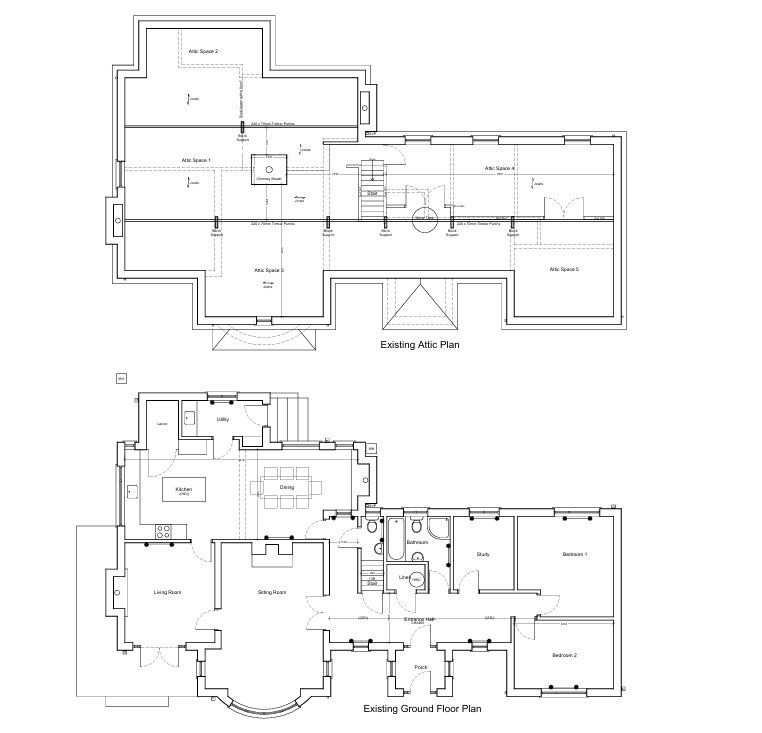
I visit your home, measure the property, assess the roof structure, check headroom and take reference photos.
Stage 2 – Loft Design Options
You receive:
existing CAD drawings
proposed layout options
stair solutions
dormer options (if included in your wish-list)
structural considerations
fire safety implications
By the end of Stage 2, you’ll know exactly whether your loft can be converted and which design approach will work best for your home..
8. Example of a Stage 1 Measured Survey Drawings

9. How Much Does a Loft Conversion Feasibility Study Cost?
Every home is different, so I provide a clear, tailored fee proposal after our initial chat. My work is carried out in structured stages, which means you stay in full control — you only move to the next step when you’re happy to do so.
What you can expect is a comprehensive service that includes:
a full measured survey
accurate existing drawings
clear design options
Planning drawings
Building Control drawings
a detailed specification booklet
structural coordination
This staged approach gives you complete transparency and removes the guesswork. You’ll always know what’s happening, what’s included and what the next step looks like — no surprises, no hidden extras.
If you’d like to explore your loft conversion, I’m happy to prepare a personalised proposal so you know exactly what’s involved.
10. Ready to Find Out If Your Loft Can Be Converted?
If you’d like me to check whether your loft is suitable for conversion, the easiest way to get started is by completing my short enquiry form. It gives me the key details I need to review your home and advise you properly.
Once I receive your form, I’ll come back to you with next steps and, if appropriate, arrange a measured survey at a time that suits you. From there, I guide the project forward in clear, manageable stages — you stay in full control throughout.
Why Choose GT Building Design
With over 40 years’ experience in residential design, I help homeowners plan extensions, conversions and internal alterations with clear drawings, practical guidance and a smooth, well‑managed process from first ideas through to approval.
I work with homeowners across North Down, Greater Belfast and the surrounding towns, supporting a wide range of projects — from small internal changes to full house extensions and larger home improvements.
You can explore my services below:
If you’re planning a home extension or thinking about improving your layout, you’re welcome to get in touch and talk through your ideas. A calm, practical chat at the start.
Loft Conversion FAQs
What are the benefits of loft conversions?
Loft conversions create valuable extra living space without extending your home’s footprint. They can increase property value, improve insulation and energy efficiency, and provide flexible rooms such as a bedroom, office or en‑suite. They also avoid the cost and disruption of moving house while making better use of space you already own.
Do I need Planning Permission for a loft conversion?
It depends on the design. Some lofts fall under Permitted Development, but when adding dormers the rules become more complex. In most cases, I recommend applying for full Planning Permission to avoid any ambiguity. I’ll advise you on the correct route once I’ve reviewed your home.
How do I know if my loft can be converted?
This is confirmed during Stages 1–2 of the Feasibility Study. I assess headroom, structure, stair placement and fire safety to determine whether a conversion is possible and what options will work best.
What is included in the Feasibility Study?
You receive existing drawings, layout options, stair solutions, dormer options (if relevant), and key structural and fire‑safety considerations.
How long does the process take?
Stage 1–2 (Feasibility) is usually completed within a couple of weeks. Planning and Building Control stages vary depending on the Council, but I guide you through each step.
Do you handle Planning and Building Control applications?
Yes — I prepare all drawings, submit the applications and liaise with the Council on your behalf.
Will a loft conversion add value to my home?
In most cases, yes. Adding a usable bedroom or office space typically increases both value and market appeal, especially in Northern Ireland where space is at a premium.
Do you work with structural engineers?
Yes — I coordinate directly with the structural engineer to ensure the design is safe, buildable and compliant.


Comments